Betelgeuse, Betelgeuse, Betelgeuse…
One of the brightest stars in the winter sky is in the news
And no, I don’t mean the fictional character played by actor Michael Keaton. In the Christmas Eve 2025 article published on the ESERO website at the end of last year, what could be seen in the night sky also included the constellation of Orion, the Hunter. Easily identified and almost resembling the mythological figure it represents, it also contains one of the brightest stars in the night sky no matter what the time of year. Betelgeuse also has a noticeable color you can see for yourself from a dark location.
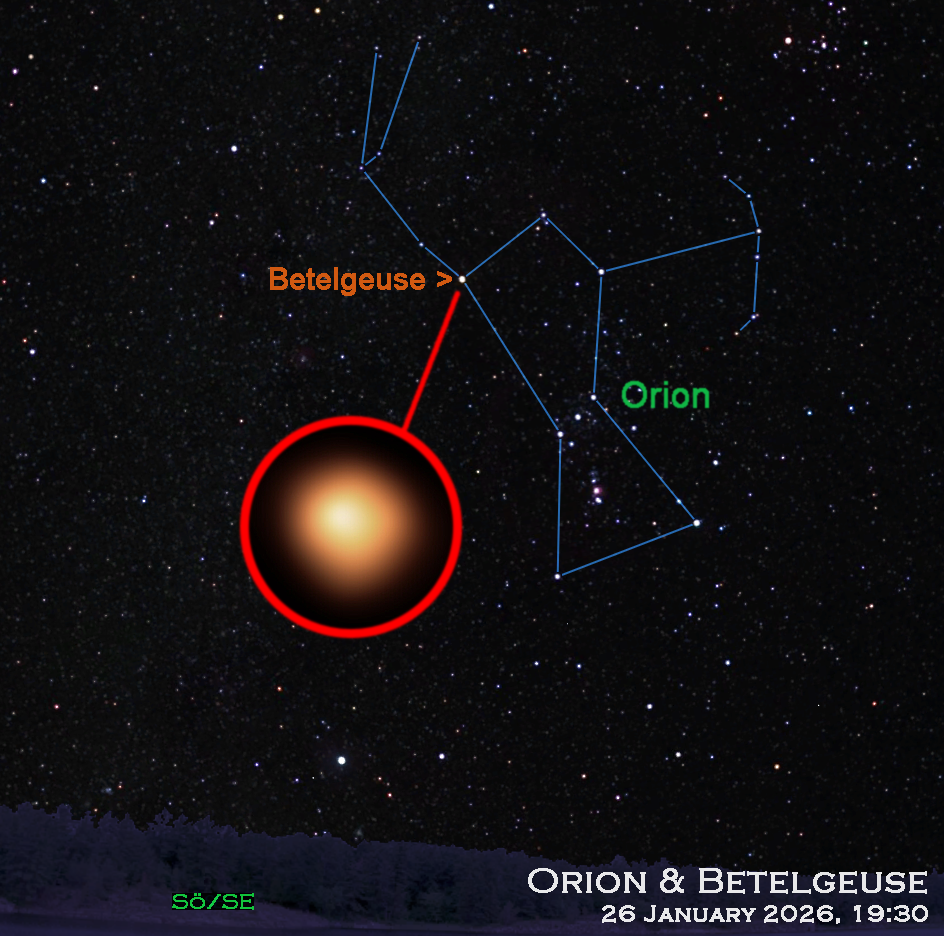
In this picture you can see the constellation of Orion, the Hunter, on a late-January evening at 19:30 in the southeastern part of the sky. It’s easily found because of his belt of three stars, all about the same brightness, in a straight line. Once you’ve found this group of stars, you’ll be able to find it for weeks ahead. The red-circle inset shows an actual image of Betelgeuse’s as observed by the SPHERE instrument on the European Southern Observatory’s Very Large Telescope. This star was one of the first to have its surface imaged, one of dozens up to maybe 99 other stars (depending on the source) this has been done for.
As you see Betelgeuse on a clear night, the light you’re observing left it between 408 and 548 years ago (or 1478 to 1618 CE based on a calendar) because that’s how many light years this star is from us.
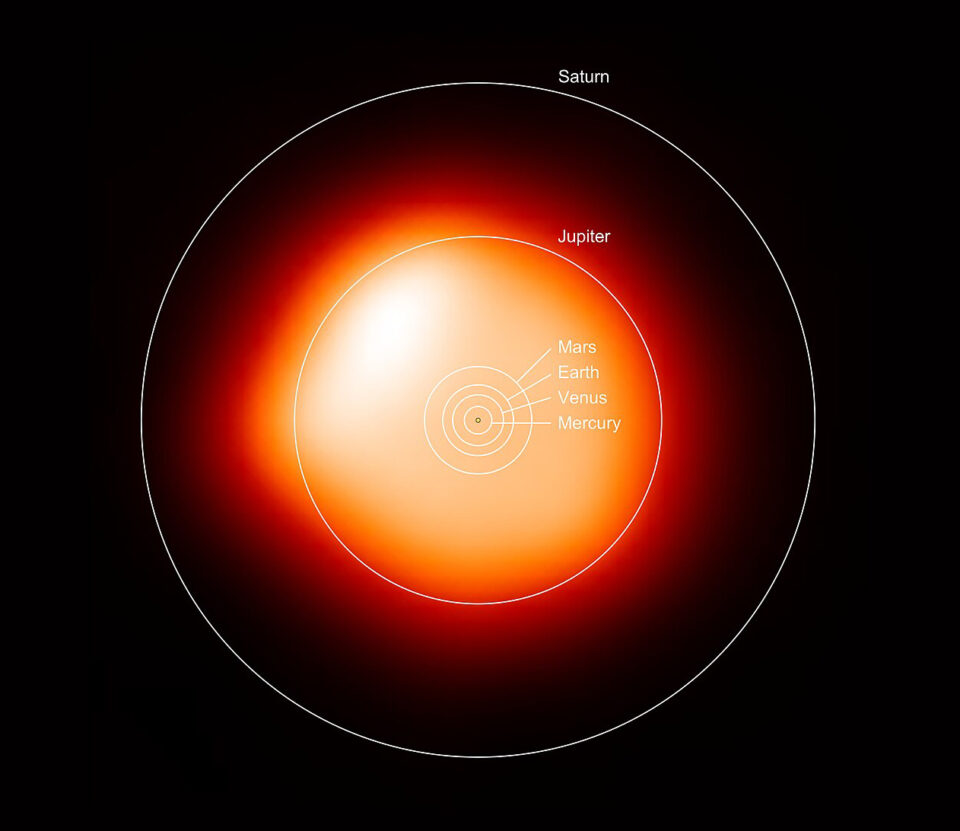
Even though Betelgeuse is this far away, it is still considered to be one of the brightest stars in the night sky. Yet it’s red-orange color tells us that it’s not very hot, which also tells us something else. It’s a supergiant, making it part of the largest diameter group of these objects. Cooler, but bigger, and it can still appear to be very bright. To put this into perspective, take a look at this artist’s montage showing Betelgeuse with a same-scale diagram of our solar system superimposed over it. Note that it extends out to past the orbit of Jupiter, which orbits the Sun at a distance over 5.2-times farther than Earth. It would take 400 million of our own Sun to fill the volume of Betelgeuse!
What we can’t see in that image is that Betelgeuse is surrounded by a complex, asymmetric envelope of material cast off by the star itself as it evolves in old age. And this isn’t small amount as it’s about 250-times its diameter. Which is what partly brings us to this week’s news item.

Observations made by the Hubble Space Telescope have shown new evidence which might help confirm the existence of a long-suspected companion star orbiting Betelgeuse. Just like a boat leaves a wake behind it as it speeds through water, there appears to be a wake being left behind this smaller object, unofficially named “Siwarha.” This artist’s concept of what’s happening shows Betelgeuse, its companion, and the dark curve, which is the wake left as Siwarha plows its way through the supergiant’s upper atmosphere.
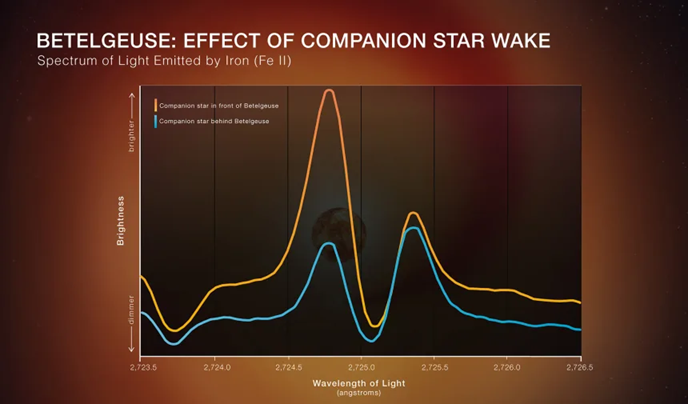
This graph shows how the companion causes changes in the light we see coming from Betelgeuse by stirring up the supergiant’s upper atmosphere. When Siwarha mixes up the material coming off of Betelgeuse due to mass loss, the supergiant brightens. When the companion is behind and its effects cannot be seen from our direction in space, Betelgeuse appears dimmer to astronomer’s instruments.
One more thing I’d like to point out is that Betelgeuse is roughly 10 million-years-old, and it evolved very rapidly, burning up its nuclear fuel in the process. As a result, it is believed it will undergo a supernova explosion, tearing it apart, within the next 100,000 years. For all we know, it may have already happened, and its bright burst of light, which will come to dominate the winter night sky, may already be on its way here. It could even show up tomorrow night. To borrow a phrase from a famous planetarium person, Jack Horkheimer, no longer with us, “Keep looking up!”
For more general information about Hubble’s finding, follow this link, and for the NASA press release, see here.
By: Tom Callen