
Spring’s on its way
We’re slowly leaving winter behind, one-sunrise-at-a-time
When one has a cat at home who thinks the time for her breakfast is in the early morning hours, you’re often up before sunrise. In her defense, she’s soon going to be 21-years-old (12 May), so it’s okay and this isn’t not one of those cases you hear about with “cats and their staff” as the joke goes.
These moments also allow the opportunity to see things in the pre-dawn sky when it’s clear out, including multiple sunrises, which can be interesting for noting the passage of time.
Everyone’s familiar with the Sun rising a little earlier each day this time of year, and right now we’re heading from winter toward spring. While there are lots of nice things to say about the coldest time of the year, I don’t know anyone not looking forward to warm, sunny days, spring flowers, and leaves on the trees once again.
In an article at the end of 2025 about the Winter Solstice (“Sun stand still”) I showed a view of the eastern horizon as seen from our island home. Since there is nothing out front besides a wide stretch of water off to different low-lying island on the horizon, it’s ideal for watching astronomical objects rise in the east.
We’ve come along far enough into the new year it’s easy to see the Sun rise off the end of the small island directly in front of our place, the same one it rises farther south along its length each Winter solstice. Time has passed, and Earth has continued its eastward motion along its orbit about our star. Using some dates along the Sun’s rising point along the horizon we can see this for ourselves.
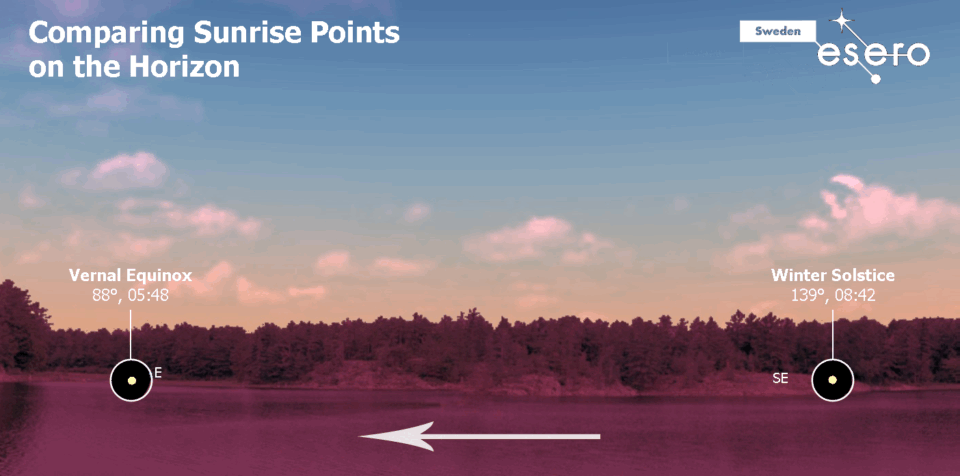
In this first example, I’ve shown the Sun at the time it’s rising for both the Winter Solstice in December, (to the right) and the Vernal Equinox in March (at the left). Since our daystar causes a glare making it impossible to be seen as just a point, I’ve made a “hole” in the horizon so it can be viewed the moment it clears the landscape.
On the Winter Solstice the Sun came up at an azimuth of 139° at 08:42 CET from our latitude here in Stockholm. For the Vernal Equinox, the day we’re looking forward to and the first day of spring in the northern hemisphere, it will rise at about 88° at 05:48 CET. During those 89 days in between these two dates, our Sun will have to have its sunrise point increase eastward by a little over 50° along the horizon. Which means it creeps in this direction some 0.56° per day in order to reach that point.
How much is this this small amount? An approximate rule of thumb is that your fist, held at arm’s length and viewed with one eye closed, covers about 10° of the background. To put it another way, the Sun would need 17.8 days of motion to cover this same angular amount.
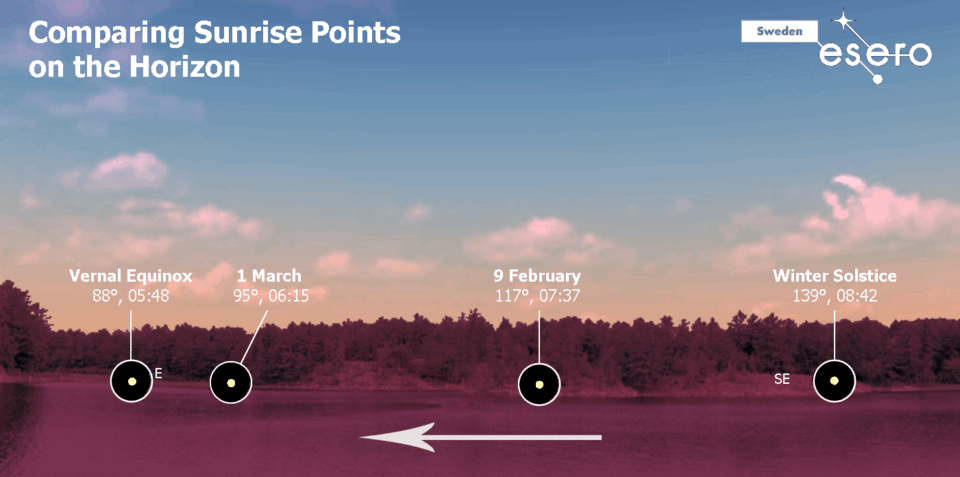
Let’s go ahead and add two more dates in the same way. This article will be published online around 9 February 2026 (sunrise at 117° at 07:37 CET), so you can see how far it’s moved since the Winter Solstice. The other addition is 1 March (95° azimuth and 06:15 CET), the first day of the next month, which is just 19 days before the Vernal Equinox. Clearly the Sun is steadily moving eastward along the horizon, and once it reaches the sunrise point for the first day of spring, it will continue in the same way until it gets to sunrise for June’s Summer Solstice. It will remain in about the same place for a few days before reversing direction and starts to make its way southward.
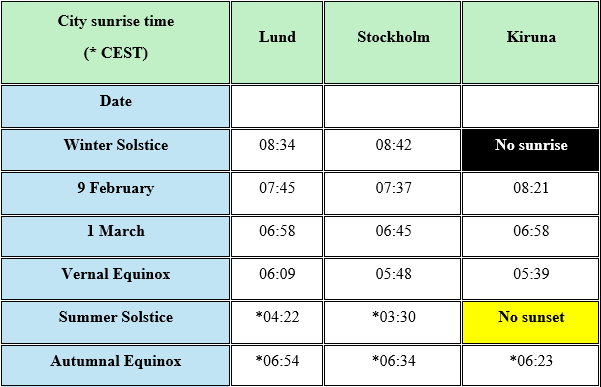
Another way to look at these changing sunrise dates over time is to compare the capital of Stockholm (59° 19’ 46” N) with two other well-known cities at the southern and northern ends of Sweden: Lund (55° 42’ 14” N), and Kiruna (67° 50’ 56” N) Besides the four dates already talked about, I’ve also included the Summer Solstice, and the Autumnal Equinox to include the other two change of seasons.
Enjoy what remains of winter 2026; Mynta, our cat, and I will do the same as we follow the sun’s movement along the horizon, on its way toward the long-awaited spring and summer.

By: Tom Callen